
On the 9th and 10th of October we will be holding the end of year meeting of the SWELL PLUS joint industry project. SWELL PLUS aims to improve oilfield inorganic scale management, particularly in more complex and challenging environments, by investigating the effect of kinetics on scale formation, deposition and inhibition. In previous phases of SWELL, scaling risk plots were developed for the sulphate scales and CaCO3 that give the critical saturation ratio (i.e., the highest saturation ratio that remains metastable within typical production timescales) as a function of temperature and hydrodynamic regime.
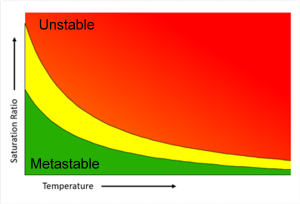
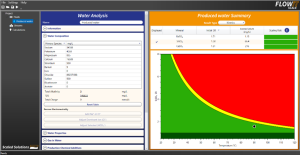
In this first year of SWELL PLUS we have been working on refining the scaling risk guideline plots by looking at the effect of divalent ions on the critical saturation ratio of a particular scale. This work has led to the production of risk plots which can more accurately predict when scaling is likely to occur. These risk plots have also been validated using field case studies and by comparison with field observations provided by project sponsors. The plots been incorporated into our scale prediction software package, FlowiT Scale, allowing both the thermodynamic saturation ratio and the kinetic prediction of the likelihood that scaling will occur, to be made quickly and easily.
Other aspects of the project have also been progressing with further investigations into the critical saturation ratios of BaSO4 at low temperatures, where it can remain stable to remarkably high saturation ratios, being carried out as well as the successful modification the jet impingement test method to allow the assessment of chemical dispersants for sulphide scaling.
